
Al Shorouk Wreck in Aqaba: A Deep Technical Wreck Lying Between Two Reefs
Dive Sites
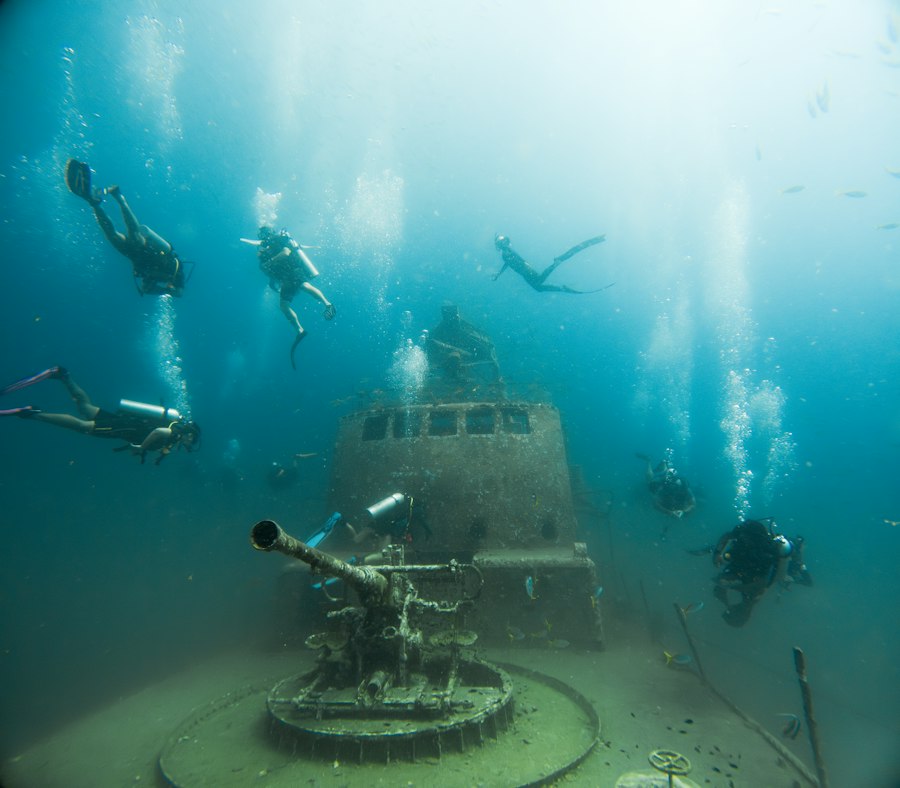
Some wrecks are a destination in themselves; the Al Shorouk wreck in Aqaba is also a reef dive. This sizeable vessel was scuttled in 2008 and came to rest on its starboard side between two coral reefs, deep enough that it belongs to technical divers rather than to the recreational schedule. Here you will learn how the ship came to lie where it does, what the depth means for your planning, which marine life has moved in, the certification and gas planning required, and how to arrange the dive with Aqaba Dive Academy on Jordan's Red Sea coast.
| Quick facts | |
|---|---|
| Depth | Deep, beyond recreational limits (no published figure) |
| Level | Technical certification or equivalent deep experience; guided; gas planning required |
| Access | Boat from South Beach |
| Dive type | Shipwreck / deep wreck-and-reef dive |
| Highlights | Hull on its starboard side between two reefs, soft corals and sponges on the exposed flank, glassfish, lionfish and lobster in the holds |
| Best for | Technical wreck divers, deep photographers, tec students planning a wreck objective |
| Nearby sites | Cedar Pride, Underwater Military Museum, The Tank (M42), C-130 Hercules, Japanese Garden |
The story of the Al Shorouk wreck
The Al Shorouk went down in 2008, more than two decades after the Cedar Pride showed Aqaba what a scuttled ship could become. It was a sizeable vessel, and it was sunk deliberately rather than lost, which is why the hull is whole and the structure safe to approach. The ship settled on its starboard side, so its port flank now faces upward into the light, and it lies in the gap between two reefs rather than on open sand.
Our dive-site page does not list the vessel's earlier name or its exact dimensions, and divers in Aqaba know the ship simply as the Al Shorouk. The result is a large steel reef that has had well over a decade to gather life, with living coral on both sides.
How deep is the Al Shorouk wreck, and what does the dive profile look like?
Aqaba Dive Academy lists the Al Shorouk as a deep, technical dive without attaching a single depth figure to it, because the wreck is approached on a plan rather than a number. What you need to know is that the dive lies beyond recreational limits: it cannot be done as a no-decompression dive on a single cylinder, and an Advanced Open Water certification to 30 m does not cover it.
The boat moors above the site after a short run from South Beach, and the team descends on a line. The profile is typically a bottom phase along the exposed flank and across the holds, a turn at an agreed pressure or time, and a staged ascent with decompression stops in open water above the reefs. The gulf is normally calm, with little current and visibility often 15 to 40 m, so the limiting factors are gas and time, not conditions.
What will you see: a wreck and a reef in one dive
The exposed flank is the showpiece. Soft corals and sponges have colonized the upturned side of the hull since 2008, and because the wreck sits between two reefs, the coral life of its neighbors spills across onto the steel. Inside the holds and the superstructure, glassfish fill the dark spaces in dense clouds, lionfish hover at the openings waiting for them, and lobsters tuck their antennae into the recesses.
Move off the wreck and the sand between the reefs has its own cast: reef fish working the edges, and occasional rays gliding across the open bottom. This combination sets the Al Shorouk apart from Aqaba's other deep sites. You get a shipwreck and two reefs in a single descent, which rewards a well-planned route far more than an aimless tour.
Who can dive the Al Shorouk? Certification, experience and gas planning
This is a technical dive. To join a trip you need a technical decompression certification, or deep experience we can verify as equivalent, and every dive is led by a guide who knows the wreck and the reefs around it. If technical diving is new to you, it means diving with a planned decompression obligation and with backups for every critical piece of equipment: two independent gas supplies, a team plan for depth, time and gas, and training to solve problems at depth rather than by ascending.
Before the dive, the team works through:
- The bottom gas and its maximum operating depth.
- The decompression schedule and any dedicated decompression gas.
- Minimum gas reserves to bring two divers to the surface with all stops completed.
- Turn pressure, run time, and the lost-buddy and lost-line procedures.
The route to this dive from a recreational card is a staged one. Take the PADI Advanced Open Water course, add the Deep Diver specialty, log experience on Aqaba's deeper reefs, then enroll in technical decompression training. Our guide to advanced diving courses in Aqaba describes each step, and the courses page has the current list. Wreck training is also worth having before you look into any hold.
Photography tips for the Al Shorouk
The upturned flank with its soft corals is the frame you came for, so give it your widest lens and a strobe on each side to lift the pinks and oranges out of the deep blue. Position a buddy on the far side of the hull for scale. Keep the holds for a single well-planned shot of the glassfish with a torch raking across them, and stay outside the openings unless you are wreck-trained and the plan includes penetration. Decide your sequence on the surface: decompression time is fixed, and the camera must not drive the dive.
Responsible diving on a deep wreck in the Aqaba Marine Reserve
Deep does not mean out of reach of the rules. The Al Shorouk sits in the waters of the Aqaba Marine Reserve, where touching, collecting, feeding and gloves are all prohibited and boats tie to mooring buoys instead of anchoring on the reef. With a reef on either side of the wreck, a careless fin stroke lands on living coral rather than sand, so trim flat, slow down near the reef faces and stage your decompression well clear of them. For why these reefs are special, read our guide to Aqaba's coral reefs and responsible diving.
Nearby dive sites to combine with the Al Shorouk
The Al Shorouk is a one-dive morning for most technical teams. On the following days, the Taiyong wreck is the obvious second deep wreck in Aqaba, and the Cedar Pride makes a relaxed recreational contrast. The Underwater Military Museum suits an Advanced afternoon, and the Japanese Garden is the gentle shallow dive that finishes a tec week well. Our wreck diving in Aqaba guide ranks every wreck by the level it needs.
Book this dive with Aqaba Dive Academy
To dive the Al Shorouk, send us your certification level, a logbook summary and the gases you plan to use, and our PADI 5-Star and CMAS instructors will build the dive plan with you before the boat leaves South Beach. Teams stay small, your underwater photos are included free, and we pick you up anywhere in Aqaba at no extra cost. Guided dives start from $30; ask about technical dive arrangements when you book. See the Al Shorouk wreck page, complete the booking form, or message +962 79 264 5333 on WhatsApp.
FAQ
How deep is the Al Shorouk wreck in Aqaba?
Our dive-site page classifies the Al Shorouk as deep, beyond recreational limits, and does not publish a single depth figure. The dive requires planned decompression and is run only for technical divers.
When was the Al Shorouk sunk?
The vessel was deliberately scuttled in 2008. It settled on its starboard side between two reefs, which is why divers see soft coral on the exposed flank and reef fish on both sides.
Can I dive the Al Shorouk with an Advanced Open Water certification?
No. Advanced Open Water covers no-decompression dives to 30 m. The Al Shorouk requires technical decompression certification or verified equivalent deep experience, and a guide.
Is the Al Shorouk a boat dive?
Yes. The site is reached by boat from South Beach, and the boat ties to a mooring rather than anchoring on the reefs beside the wreck.
What will I see on the Al Shorouk wreck?
Soft corals and sponges on the exposed flank, glassfish, lionfish and lobster in the holds and superstructure, and reef fish with occasional rays over the sand between the two reefs.
Ready to dive? Book with Aqaba Dive Academy or call +962 79 264 5333.
Book now