
Rainbow Reef Aqaba Night Dive: What You See After Dark and How It Works
Dive Sites
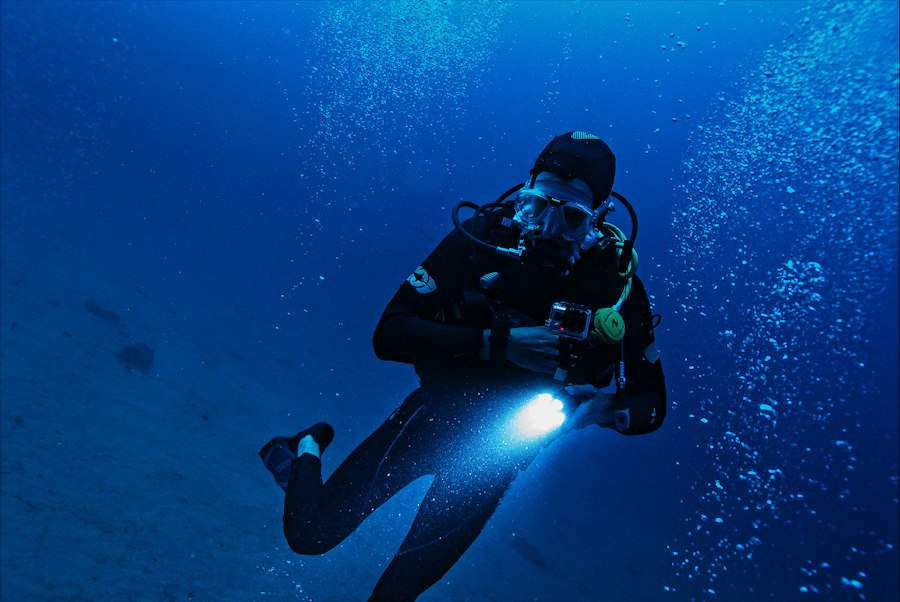
Divers who have logged a Rainbow Reef Aqaba night dive tend to describe the same thing: a reef they thought they knew turning into a different place once the sun goes down. Rainbow Reef is a shallow coral reef in the Gulf of Aqaba with a clear reef line that is easy to follow, which is why it is Aqaba's favorite night dive and the site most guides choose for a first dive after dark. This guide covers the reef by day, what emerges at night, how a night dive is run from torch to signals, who can join and how to book with Aqaba Dive Academy on Jordan's Red Sea coast.
| Quick facts | |
|---|---|
| Depth | 5–20 m |
| Level | All levels; night dives with a guide, Night adventure dive or Night Diver specialty recommended |
| Access | Shore and boat |
| Dive type | Coral reef with a clear, easily navigated reef line; Aqaba's classic night dive |
| Highlights | Spanish dancers, basket stars, hunting lionfish, parrotfish asleep in mucus cocoons, feeding crustaceans |
| Best for | First night dives, Night specialty training, macro photographers, relaxed day dives |
| Nearby sites | Japanese Garden, Seven Sisters, King Abdullah Reef, Coral Garden |
Why is Rainbow Reef Aqaba's favorite night dive?
Night diving rewards simplicity, and Rainbow Reef is simple in the ways that matter. The reef runs as a clear line with the shore on one side and open water on the other, so navigation comes down to keeping the reef on your left going out and on your right coming back. A depth range of 5–20 m means the whole dive can be planned shallow, and the site is reached from shore as well as by boat.
Add the gulf's usual conditions, little swell, mild or no current and water of about 21 °C in winter and 27 °C in summer, and you have a reef where a group can descend at dusk, move slowly and surface with air to spare. That is why Rainbow Reef heads the list of Aqaba night dive sites for everyone from first-timers to photographers.
Rainbow Reef by day
Dive it in daylight first and you will understand the layout you will later follow by torch. Hard and soft corals cover the reef line, parrotfish crunch at the coral, angelfish cruise in pairs, wrasse dart between the heads and clouds of anthias hover over the branches. Visibility is commonly 15–40 m, and the reef is bright enough for photos without a strobe. Many divers do exactly this: an afternoon dive on Rainbow Reef, a surface interval, then the same reef in the dark.
What will you see on a Rainbow Reef night dive?
The cast changes completely after dark.
- Spanish dancers. Large red nudibranchs that swim by rippling the edges of their mantle, and the signature animal of a Rainbow Reef Aqaba night dive. Watch, photograph, do not touch.
- Basket stars. Coiled into tight knots by day, at night they climb onto coral heads and unfurl a lattice of branching arms to feed. Keep your beam moving; held on them too long, it makes them curl up again.
- Hunting lionfish. Lionfish use the edge of your torch beam to spot the small fish it reveals, and will shadow a diver along the reef. Keep your light off the prey they are stalking, and never try to move a lionfish on.
- Sleeping parrotfish. Wedged into crevices inside a transparent mucus cocoon they spin each evening, which masks their scent from predators. A brief look is fine; prolonged light disturbs them.
- Crustaceans. Shrimp eyes glow like pinpricks in the beam, crabs and hermit crabs pick over the reef, and the sand that looked empty by day is alive with small feeders.
Cover your torch against your chest for a moment and wave a hand: on many nights the water sparkles with bioluminescent plankton.
How a night dive works at Rainbow Reef
Your torch
You carry a primary torch and a backup, and both are checked before you enter. Never shine a beam into another diver's eyes; to communicate, point your torch at your own hand and make the normal hand signal.
Light signals
A large, slow circle with the beam means "OK?" and "OK". A rapid side-to-side wave means "attention" or "problem". Your guide usually carries a marker light so the group can find them at a glance.
Buddy and group
You stay closer to your buddy than by day, within easy torch sight, and the group moves slowly in a tighter formation behind the guide, who sets a conservative turn pressure.
Navigation and the plan
At Rainbow Reef the reef line does the work: reef on one side out, the other side back. From shore, lights on the beach mark the exit; from a boat, a light on the boat marks the ascent point. Most night dives enter at dusk so your eyes adjust as the light fades, stay shallow, run a little shorter than a day dive, and end with a safety stop and a slow ascent toward the surface lights.
Who can join a night dive at Rainbow Reef?
Any certified diver who is comfortable with buoyancy can join a guided night dive here; the site suits all levels, and night dives are part of our regular services. For formal training, the Night adventure dive is one of the electives of the PADI Advanced Open Water course, and a PADI specialty course in night diving goes further into planning, lights and navigation. Nervous about the dark? A first dusk dive at the shallow Black Rock training site is a gentle warm-up.
Diving responsibly on Rainbow Reef inside the Aqaba Marine Reserve
Rainbow Reef is one of the reefs of the southern coast protected by the Aqaba Marine Reserve, a marine park since 1997 and a national reserve since 2020. After dark the rules gain extra meaning. No touching applies to Spanish dancers as much as to coral; no feeding or chasing includes not steering prey toward a lionfish with your beam; buoyancy matters more when you cannot see the reef below your fins; and boats tie to fixed mooring buoys rather than dropping anchor. Give sleeping fish a brief look and move on, and leave the reef exactly as you found it. Read more in our guide to Aqaba's coral reefs and responsible diving.
Nearby dive sites to combine with Rainbow Reef
For the daylight half of your day, Rainbow Reef pairs with the Japanese Garden and its large coral heads, with Seven Sisters for macro photography among seven pinnacles, with King Abdullah Reef for turtles along the slope, or with the Coral Garden for an easy, current-free coral forest.
Book this dive with Aqaba Dive Academy
Aqaba Dive Academy runs Rainbow Reef as a guided night dive in small groups led by PADI 5-Star and CMAS instructors, with torches and full equipment available and a thorough briefing before you enter. Underwater photos of your dive are free, and free transport from anywhere in Aqaba comes with every booking, which matters when you are heading home after dark. Guided dives start from $30. Visit the Rainbow Reef dive site page, book online, or WhatsApp +962 79 264 5333 to reserve an evening.
FAQ
How deep is Rainbow Reef in Aqaba?
Rainbow Reef ranges from about 5 m to 20 m. Night dives are usually planned in the shallower part of that range, well within Open Water limits.
Do I need a special certification for a night dive in Aqaba?
No. Any certified diver can join a guided night dive at Rainbow Reef. The Night adventure dive of the Advanced Open Water course and the Night Diver specialty are recommended if you want to build the skills formally.
What time does a Rainbow Reef night dive start?
Night dives normally enter the water at dusk, so your eyes adjust as the light fades and the reef's nocturnal animals are just beginning to emerge.
What is a Spanish dancer?
A Spanish dancer is a large red nudibranch, a type of sea slug, that swims by rippling the edges of its body. It is mostly active at night and is the animal most divers hope to see on a Rainbow Reef night dive.
Is Rainbow Reef a shore dive or a boat dive?
Both are possible. Rainbow Reef can be dived from the shore or from a boat, and your guide will choose the entry that suits the group and the conditions.
Ready to dive? Book with Aqaba Dive Academy or call +962 79 264 5333.
Book now