
Taiyong Wreck in Aqaba: A Technical Diver's Guide to the Deep Tugboat
Dive Sites
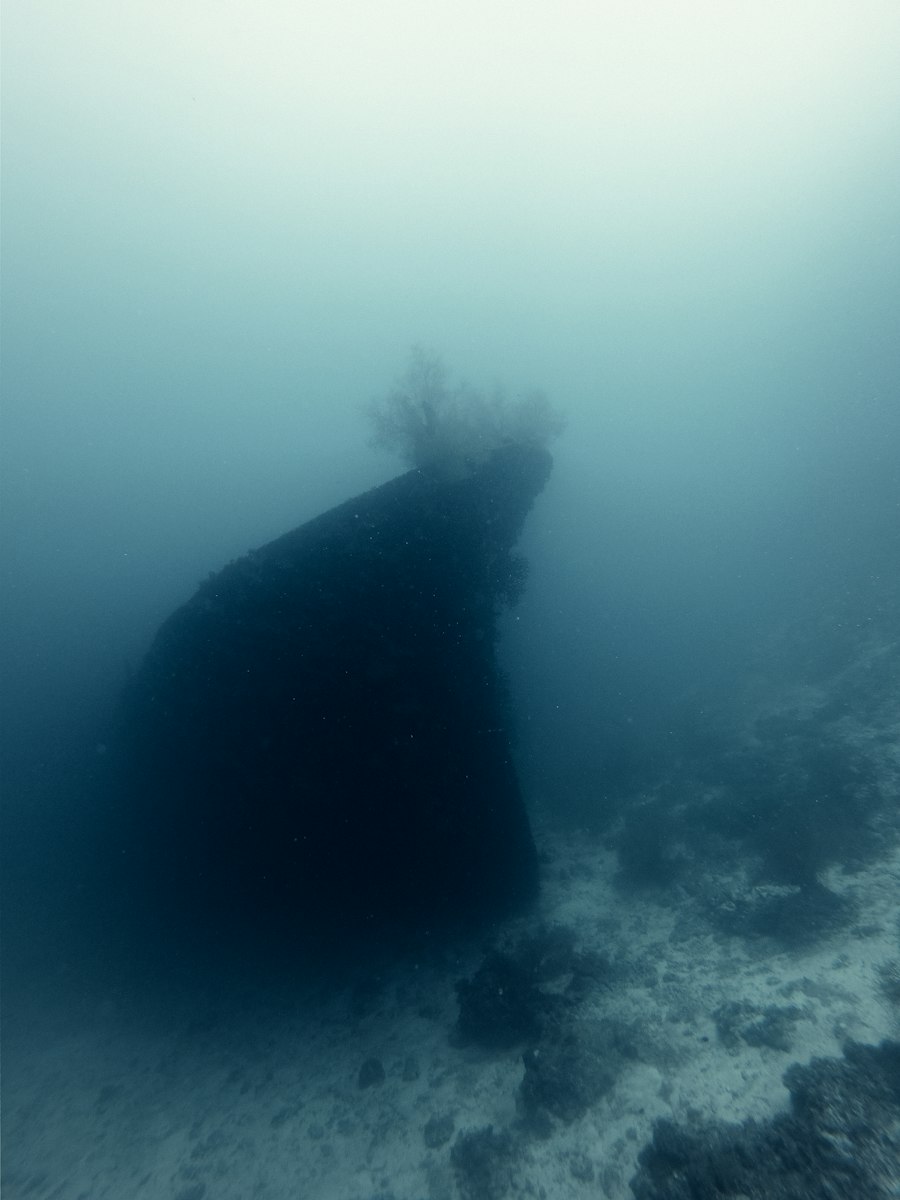
Most of Aqaba's wrecks were placed where any certified diver can reach them. The Taiyong wreck in Aqaba is the exception. This tugboat rests from about 28 m downward on the floor of the Gulf of Aqaba, past the point where ordinary no-stop diving makes sense, and it was sunk for divers who plan their dives differently. This guide covers why the tug is there, what "technical diving" means in plain terms, the certification and gas planning required, what lives on the hull, and how Aqaba Dive Academy arranges the trip on Jordan's Red Sea.
| Quick facts | |
|---|---|
| Depth | From 28 m downward, beyond recreational limits |
| Level | Technical certification or equivalent deep experience; guided; gas planning required |
| Access | Boat from South Beach |
| Dive type | Tugboat wreck / deep artificial reef |
| Highlights | Intact tug coated in coral and sponge, deck fittings, large groupers, schooling snapper |
| Best for | Certified technical divers, deep-wreck photographers, tec students on a training dive |
| Nearby sites | Cedar Pride, Underwater Military Museum, The Tank (M42), C-130 Hercules |
Why was a tugboat sunk in deep water off Aqaba?
Aqaba's artificial-reef programme is best known for mid-depth attractions such as the Cedar Pride and the two aircraft. The Taiyong was placed with a different brief. This tugboat was sunk in deep water to create deep-water habitat and to give technical divers in Jordan a dedicated target of their own.
Because few divers can reach it, the tug has stayed undisturbed, and the growth on it has never been worn down by crowds. The year of the sinking and the dimensions of the vessel are not published on our site, and we would rather say so than guess; what matters for your planning is the depth.
How deep is the Taiyong wreck, and what does "beyond recreational limits" mean?
The shallowest part of the Taiyong lies at around 28 m, and the hull continues deeper from there. In recreational diving you stay within no-decompression limits and can ascend directly to the surface at any point, pausing only for a safety stop at 5 m. At the depth of the Taiyong those limits become short, and a meaningful tour of the wreck pushes past them, which means you take on a decompression obligation: scheduled stops on the way up that cannot be skipped.
Your gas supply has to cover the bottom time, the ascent, every stop and a reserve for an emergency, with no option of heading straight up. Light is lower at this depth, so the wreck sits in a blue twilight even at midday, and nitrogen narcosis is a factor for every diver breathing air. Expect a fixed run time, a slow ascent along a line and a long hang in open water before surfacing.
What is technical diving, in plain language?
Technical diving is diving planned around a decompression obligation, extra depth or an overhead environment, using equipment and procedures that give you a backup for every critical system. In practice that means:
- Two independent gas supplies, in a twinset or sidemount cylinders, so a single failure never leaves you without gas.
- A written plan for depth, time, gas volumes and the decompression schedule, agreed with the team before the dive.
- Often a separate cylinder of oxygen-rich gas to shorten the decompression stops.
- Training in solving problems at depth without ascending, because ascending is no longer an immediate option.
None of this should put off an Open Water or Advanced diver. It is a progression, and Aqaba is a comfortable place to make it: calm water, visibility often 15–40 m, and the wreck minutes from the beach.
Who can dive the Taiyong wreck? Training and gas planning
Aqaba Dive Academy takes divers to the Taiyong only when they hold a technical decompression certification, or can document equivalent deep experience, and always with a guide who knows the wreck. An Advanced Open Water card, which certifies you to 30 m, is not enough: the Taiyong starts near the bottom of that limit and the dive goes deeper.
Gas planning is the heart of the preparation, and before the boat leaves the team confirms:
- Bottom gas and the maximum depth it is safe for.
- The decompression schedule and the gas used for the stops.
- Minimum gas: the volume kept in reserve to bring two divers to the surface with every stop completed.
- Turn pressure and run time, so everyone leaves the wreck at the same moment.
The training path is clear. Complete the PADI Advanced Open Water course, add the Deep Diver specialty through our specialty course, build experience on Aqaba's deeper reefs, then move into technical decompression training. Our guide to advanced diving courses in Aqaba lays out the steps, and the courses page lists what is on offer.
What will you see on the Taiyong wreck?
The tug is intact, and the years of isolation show. Coral and sponge coat the hull, the deck fittings and the superstructure, and in the limited light the colors look muted until a torch brings them back. Large groupers have claimed the wreck as home and watch divers from the shelter of the deck, while snapper school over the structure in a slow, shifting mass. Glance into the blue now and then: pelagic fish pass this way.
Photography tips in low light
Light, not lens, is the challenge here. Bring a strong video light or twin strobes, set your white balance before you descend, and decide in advance which two or three shots you want, because run time is fixed and there is no second attempt. A wide-angle lens with a diver and torch beam in frame gives the wreck scale and conveys the twilight better than a flash-lit close-up.
Diving responsibly on a deep wreck in the Aqaba Marine Reserve
The Taiyong lies within the waters of the Aqaba Marine Reserve, and the reserve's rules do not relax with depth: nothing is touched or collected, gloves stay in the bag, boats tie to mooring buoys rather than anchoring, and marine life is never fed. Technical divers carry more equipment than most, so clip off stages and reels before you reach the wreck, and keep the decompression line clear of the coral below. Our guide to Aqaba's coral reefs and responsible diving explains why they are worth the discipline.
Nearby dive sites to combine with the Taiyong
A technical dive on the Taiyong is usually the single dive of the morning, given the decompression involved. On other days of a tec trip, the Al Shorouk wreck and Yellowstone Reef are the natural companions, and Paradise adds a deep wall and cave. For a recreational afternoon, the Cedar Pride is close by. Every Aqaba wreck and its required level is covered in our wreck diving in Aqaba guide.
Book this dive with Aqaba Dive Academy
Tell us your certification, your logged experience and the gas you intend to dive, and our PADI 5-Star and CMAS team will confirm whether the Taiyong is a fit and plan it with you before the boat leaves South Beach. Groups stay small, transport from anywhere in Aqaba is free, and photos from the dive are included. Guided dives start from $30; ask about technical dive arrangements when you enquire. Visit the Taiyong wreck page, use the online booking form, or WhatsApp +962 79 264 5333.
FAQ
How deep is the Taiyong wreck in Aqaba?
The shallowest part of the tug lies at about 28 m and the wreck continues deeper, which places it beyond recreational no-decompression limits. No maximum depth figure is published, so plan the dive with your guide.
Can I dive the Taiyong with an Advanced Open Water certification?
No. Advanced Open Water certifies you to 30 m without decompression stops, and the Taiyong requires planned decompression. You need technical certification or documented equivalent deep experience, and a guide.
What is technical diving?
Technical diving uses redundant gas supplies, planned decompression stops and detailed gas planning to dive deeper or longer than recreational limits allow. It requires dedicated training beyond the Advanced level.
What equipment and gas do I need for the Taiyong wreck?
Two independent gas supplies, a decompression-capable dive computer and a torch at minimum. Bottom gas, decompression gas and reserves are agreed with your guide in planning; the Taiyong is never dived on a single cylinder.
When was the Taiyong sunk?
We do not have a confirmed year for the sinking, so we do not publish one. The tug was placed deliberately in deep water to create habitat and give technical divers a dedicated wreck.
Ready to dive? Book with Aqaba Dive Academy or call +962 79 264 5333.
Book now